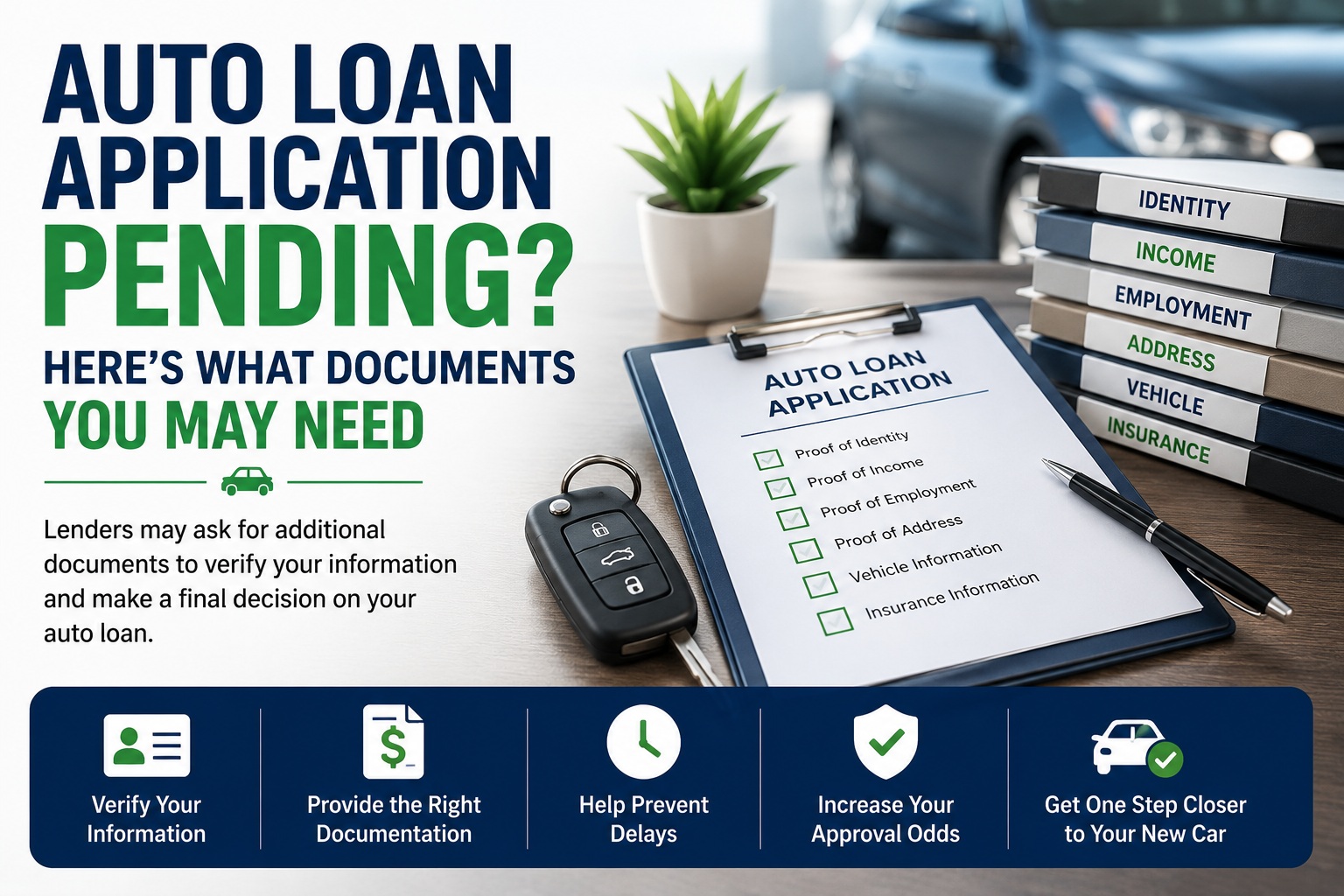
You submitted your auto loan application and now you're waiting.
So... what happens next?
If your lender or dealership has asked you to provide additional documents, don't panic. This is a common part of the auto financing process. The lender may simply need to verify information from your application before making a final decision.
Having the right paperwork ready can help prevent unnecessary delays. Requirements vary by lender, but knowing what documents are commonly requested can help you prepare before they ask.
What Happens After You Apply for an Auto Loan?
After you submit an application, a lender may review several parts of your financial profile, including your credit history, income, employment, housing situation, existing debts, and the vehicle you're planning to purchase.
You may receive an approval, a conditional approval, a request for additional information, or a denial.
If you're asked for documentation, it usually means the lender wants to verify information you provided on your application. For example, a lender may ask for proof of income if your stated income needs to be confirmed.
Don't assume that being asked for documents means something is wrong with your application. It may simply be the next step in the lender's review.
1. Proof of Identity
One of the first things a lender may need to verify is that you are who you say you are.
Be prepared to provide a valid government-issued identification document, such as:
- Driver's license
- State-issued identification card
- Passport or other acceptable government-issued ID
You may also need to provide personal information such as your Social Security number and date of birth.
Tip: Make sure your name and other identifying information are consistent across your application and documents. Differences caused by a recent name change or outdated information may require additional verification.
2. Proof of Income
Income verification is one of the most common parts of the auto loan process.
Lenders want to determine whether your income is sufficient to support the proposed monthly payment and your other financial obligations. Depending on your situation, you may be asked for documents such as:
- Recent pay stubs
- W-2 forms
- Recent bank statements
- 1099 forms
- Tax returns
- Documentation of retirement or government benefits
- Documentation of other income you want the lender to consider
The exact documents required can vary significantly between lenders.
For example, Experian notes that lenders may accept current pay stubs, bank statements, W-2s, 1099s, and recent tax returns when verifying income for an auto loan.
What if you're self-employed?
If you own a business or work as an independent contractor, income verification may require more documentation.
A lender could request tax returns, 1099 forms, bank statements, or other records that demonstrate your income.
This doesn't necessarily mean self-employed applicants cannot qualify. It simply means your income may require a different type of verification.
3. Proof of Employment
Your lender may also want to verify your current employment.
You may be asked to provide:
- Employer name and contact information
- Recent pay stubs
- Employment verification
- A W-2
- Other documentation showing your current employment
In some cases, the lender may verify your employment directly rather than asking you to provide a separate document.
Your employment history can also be relevant because lenders may consider the stability of your income when evaluating an application.
4. Proof of Address or Housing
Don't be surprised if the lender asks about where you live.
Your application may include information about whether you rent or own your home and how much you pay for housing. A lender may request documentation to verify this information.
Depending on the lender, acceptable documentation could include:
- Lease agreement
- Mortgage statement
- Utility bill
- Bank statement
- Other official correspondence showing your current address
Keep in mind that not every lender will require these documents.
5. Bank Statements or Other Financial Records
A lender may ask for bank statements when additional financial verification is needed.
Bank statements can help document income, deposits, assets, or other financial information relevant to your application.
If you're asked for bank statements, check the lender's instructions carefully. They may specify how many months of statements they need and whether they want complete statements rather than screenshots of individual transactions.
Important: Don't send more financial information than the lender requests. Use the lender's secure upload system whenever possible.
6. Information About the Vehicle
If you haven't selected a vehicle yet, you may not need all of this information immediately.
Once you've chosen a car, however, the lender may need details about the vehicle being financed, such as:
- Vehicle identification number (VIN)
- Year
- Make and model
- Purchase price
- Dealer information
- Mileage
- Down payment amount
- Trade-in information, if applicable
The vehicle is typically the collateral securing an auto loan, so the lender may evaluate the vehicle as part of the financing process.
7. Proof of Insurance
Before you drive your newly financed vehicle away, you'll generally need to arrange appropriate auto insurance.
Your lender may require proof of insurance before the loan can be finalized or the vehicle can be released.
If you're buying a vehicle, ask the dealership or lender exactly what insurance coverage is required and when proof needs to be provided.
Having your insurance information ready can help prevent a last-minute delay.
8. Down Payment and Trade-In Information
If you're making a down payment, be prepared to show how you'll be paying it if the lender or dealer requests verification.
If you're trading in another vehicle, you may also need information such as:
- Current vehicle registration
- Vehicle title
- Existing loan information
- Current payoff amount
- Vehicle details
If you still owe money on your trade-in, ask the dealer for the exact payoff amount being used in the transaction.
9. Additional Documents for Special Situations
Some applicants may need to provide additional documentation because their financial situation doesn't fit a standard salaried-employee application.
For example, you may receive additional requests if you:
- Are self-employed
- Work as an independent contractor
- Have multiple sources of income
- Receive retirement or government benefits
- Have recently changed jobs
- Are using a co-signer
- Are applying jointly with another person
- Have recently moved
- Have recently changed your name
If you're using a co-signer, that person may need to provide their own personal, income, and credit information because their financial profile becomes part of the application.
The Most Important Thing: Follow Your Lender's Checklist
There's no single universal list of documents required for every auto loan.
One lender might verify your information electronically, while another might ask you to upload pay stubs, bank statements, or tax documents.
That's why you shouldn't prepare a huge stack of paperwork and send everything at once.
Instead, look at the lender's specific request and provide exactly what they ask for.
If the lender says it needs your two most recent pay stubs, for example, send those rather than several years of financial records.
Before submitting anything, check:
- Is every page included?
- Is the document readable?
- Is the information current?
- Does your name match your application?
- Is the document in the requested format?
- Did you provide all requested pages?
- Are you uploading it through the lender's secure system?
Incomplete or outdated documentation can create another round of requests and potentially slow down the process.
How to Prepare While You're Waiting
If you've already applied for an auto loan and are waiting for the lender's next step, now is a good time to organize your documents.
Create a folder on your computer or phone and gather your most recent:
Personal documents:
Driver's license or other government-issued ID, Social Security information, and proof of address.
Income documents:
Recent pay stubs, W-2s, 1099s, tax returns, or other income documentation that applies to you.
Financial documents:
Recent bank statements and information about your down payment.
Vehicle documents:
Purchase information, VIN, dealer information, trade-in paperwork, and insurance information when available.
You don't necessarily need to send these documents until your lender requests them. The goal is simply to have them ready.
What If the Lender Keeps Asking for More Documents?
This can be frustrating, especially when you thought your application was already complete.
However, additional documentation doesn't automatically mean your loan is going to be denied.
A lender may discover during verification that it needs clarification or more recent information. For example, a pay stub might not contain enough information to verify your income, or a self-employed applicant may need to provide additional records.
If you're unsure why something is being requested, ask the lender:
"Can you tell me exactly what information this document is being used to verify?"
That's a simple question that can help you understand what is happening and avoid submitting unnecessary paperwork.
How Long Does Auto Loan Verification Take?
There isn't one standard timeline.
Some applications can move quickly when the lender can electronically verify the information. Others may take longer if additional documents are required, information needs to be clarified, or the lender is waiting for verification from an employer or another source.
The fastest thing you can control is your response time.
If your lender requests a document and you can safely provide it the same day, doing so may help keep your application moving.
Bottom Line: Get Your Documents Ready Before They're Requested
Waiting for an auto loan decision can feel like you're stuck in limbo, but there are useful things you can do while you wait.
Have your identification, income records, employment information, proof of address, financial records, insurance information, and vehicle paperwork organized and ready.
You probably won't need every document listed in this article. Lenders have different requirements, and your specific situation will determine what you need to provide.
The key is to respond quickly, provide accurate information, and use the lender's secure document-submission process.
That way, when the message finally arrives saying "We need a few more documents," you're already prepared.